
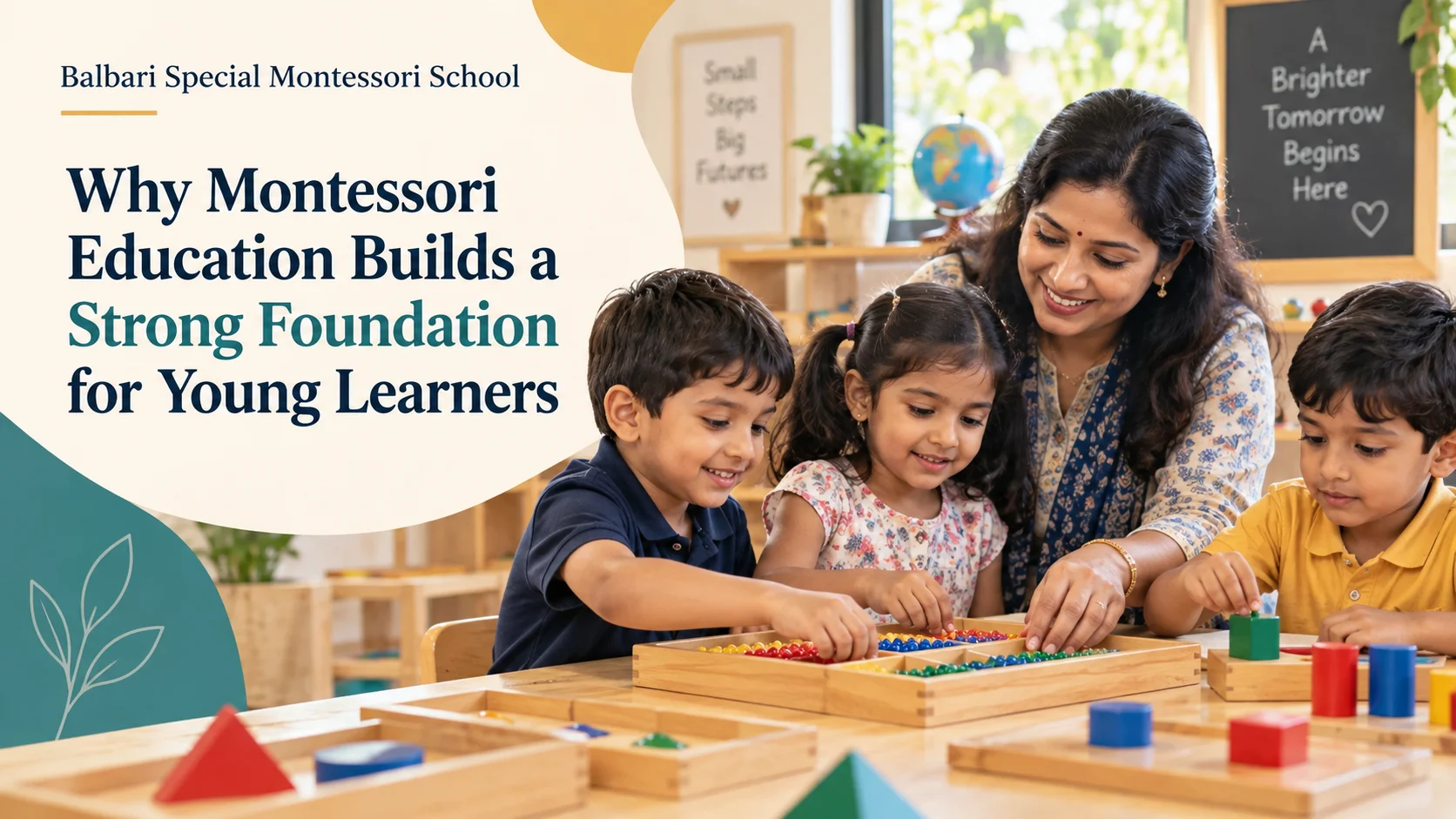
A foundation that goes beyond textbooks
The early years of education shape how children approach learning, relationships, and everyday challenges. A child who feels comfortable asking questions, exploring ideas, and trying again after a mistake begins to develop habits that can support learning for years. Choosing a school therefore involves more than looking at books or examinations. It means considering the environment in which a child will grow.
Montessori education places the child at the centre of this process. It encourages purposeful activity, careful observation, and increasing independence. Balbari Special Montessori School identifies the Montessori method as a defining feature of its educational approach. For parents exploring schooling in Sardarshahar, understanding these principles can help make conversations about education more meaningful.
Understanding how children learn
Children do not all understand a new idea in the same way or at the same moment. Some need to handle an object, others need to observe a demonstration, and many benefit from repeating an activity. An effective early learning environment makes room for these differences while giving children clear guidance and meaningful goals.
In a Montessori approach, learning connects movement, observation, language, and practical experience. Instead of expecting children to memorise every concept immediately, adults help them engage with it. Sorting objects, comparing sizes, matching pictures, or arranging a sequence can introduce ideas that later become part of reading, writing, and mathematics. The activity has a purpose, and the child participates actively.
Learning through hands-on experiences
An abstract explanation can be difficult for a young child to understand. A practical example often provides a clearer starting point. Counting actual objects, for instance, connects a number word to a visible quantity. Comparing containers introduces the language of size and capacity. Arranging items from smallest to largest encourages observation and reasoning.
These experiences also give teachers opportunities to notice how a child thinks. Does the child count each object carefully? Do they recognise a pattern? Can they explain why two groups are different? Such questions help adults support understanding instead of relying only on correct answers. Hands-on learning becomes especially useful when children can connect an activity to something familiar in daily life.
Encouraging independence in everyday tasks
Independence begins with small, manageable responsibilities. Putting materials back in their place, opening a lunchbox, organising a school bag, or completing an activity before moving on can help a child participate more confidently in the day. Adults still provide support, but they allow children to attempt tasks that match their abilities.
The aim is not to expect young children to manage everything alone. It is to give them enough time, encouragement, and guidance to practise. When adults immediately complete every task for a child, opportunities for learning may be missed. A patient approach allows the child to experience effort and progress, even when a simple task takes longer than expected.
Building concentration through purposeful work
Concentration develops through practice. Children need opportunities to stay with activities that are interesting, understandable, and appropriately challenging. Constant interruptions or pressure to finish quickly can make this harder. A calm routine and thoughtfully organised materials can help children focus on one task at a time.
For example, completing a puzzle requires noticing details, trying different arrangements, and checking whether pieces fit. Matching or sorting work may require careful comparison. Adults can support these experiences by demonstrating clearly and then allowing time for the child to work. Attention should be encouraged gradually, with expectations suited to the child’s age and individual needs.
Giving curiosity room to grow
Young children naturally ask questions about the world around them. Why does a leaf change colour? Where does rain come from? Why do some objects float? These questions provide valuable starting points for conversation and exploration. Responding with interest shows children that their observations matter.
Adults do not need to turn every question into a formal lesson. Sometimes a simple explanation, a picture book, or a shared observation is enough. At other times, asking the child what they think can reveal their understanding. Encouraging curiosity helps children see learning as a process of discovery, rather than only a task completed to satisfy an adult.
Connecting academic learning with practical skills
Early academic skills and everyday skills can support one another. Following a sequence helps with classroom activities as well as daily routines. Describing an object develops vocabulary. Comparing quantities introduces mathematical thinking. Listening to instructions and explaining a choice strengthen communication.
Practical activities also help children understand that learning has a place outside the classroom. A child might count plates while helping prepare a table or identify familiar letters on a sign. These moments do not replace structured teaching, but they provide opportunities to use knowledge in meaningful settings. Parents can encourage this connection without turning the whole day into additional schoolwork.
Developing respect and cooperation
Learning in a shared space involves more than completing individual activities. Children practise waiting for a turn, handling materials carefully, listening to another person, and asking for help politely. These habits take time to develop and require consistent modelling by adults.
Clear expectations help children understand their responsibilities. If an activity belongs in a particular place, returning it allows someone else to use it. If a classmate is speaking, listening shows respect. When difficulties arise, adults can guide children towards simple explanations and fair solutions. Cooperation becomes part of everyday learning rather than a separate topic discussed only occasionally.
Supporting Montessori principles at home
Parents can encourage similar habits through simple routines. Keep frequently used belongings in accessible places, give clear instructions, and allow children to help with suitable household tasks. Offer limited choices, such as selecting between two books, while maintaining the boundaries that make daily life predictable.
Notice effort as well as results. Saying, “You kept trying until you finished,” draws attention to persistence. Avoid comparing progress with siblings or classmates. If a task repeatedly causes frustration, break it into smaller steps and ask the teacher for guidance. The strongest foundation grows through patient cooperation between home and school, with curiosity, responsibility, and confidence developing together.