
Education includes the whole child
A child’s school experience includes much more than learning to read a passage or solve a sum. Children also learn how to communicate, cooperate, express ideas, follow routines, and respond to unfamiliar situations. Academic learning matters, but it takes place alongside physical, social, emotional, and creative development.
Balbari Special Montessori School describes an educational plan that supports all-round development and includes fine arts and craft. This provides a relevant starting point for understanding why varied activities belong in a child’s education. They offer different ways to participate, practise skills, and discover interests. Source: Balbari Educational Plan
Art provides another way to express ideas
Young children cannot always explain their thoughts in detailed sentences. Drawing, colouring, modelling, and craft provide additional ways to communicate. A picture of a family, a favourite place, or an imagined animal can become the beginning of a conversation. Adults can ask the child to describe their work without deciding in advance what it should mean.
Creative activities are most useful when children have room to make choices. Selecting colours, arranging shapes, or deciding what to add next allows them to participate in the process. A child’s work does not need to resemble an adult’s example perfectly. Exploring materials and explaining choices can be as valuable as the finished piece.
Craft connects planning with practical action
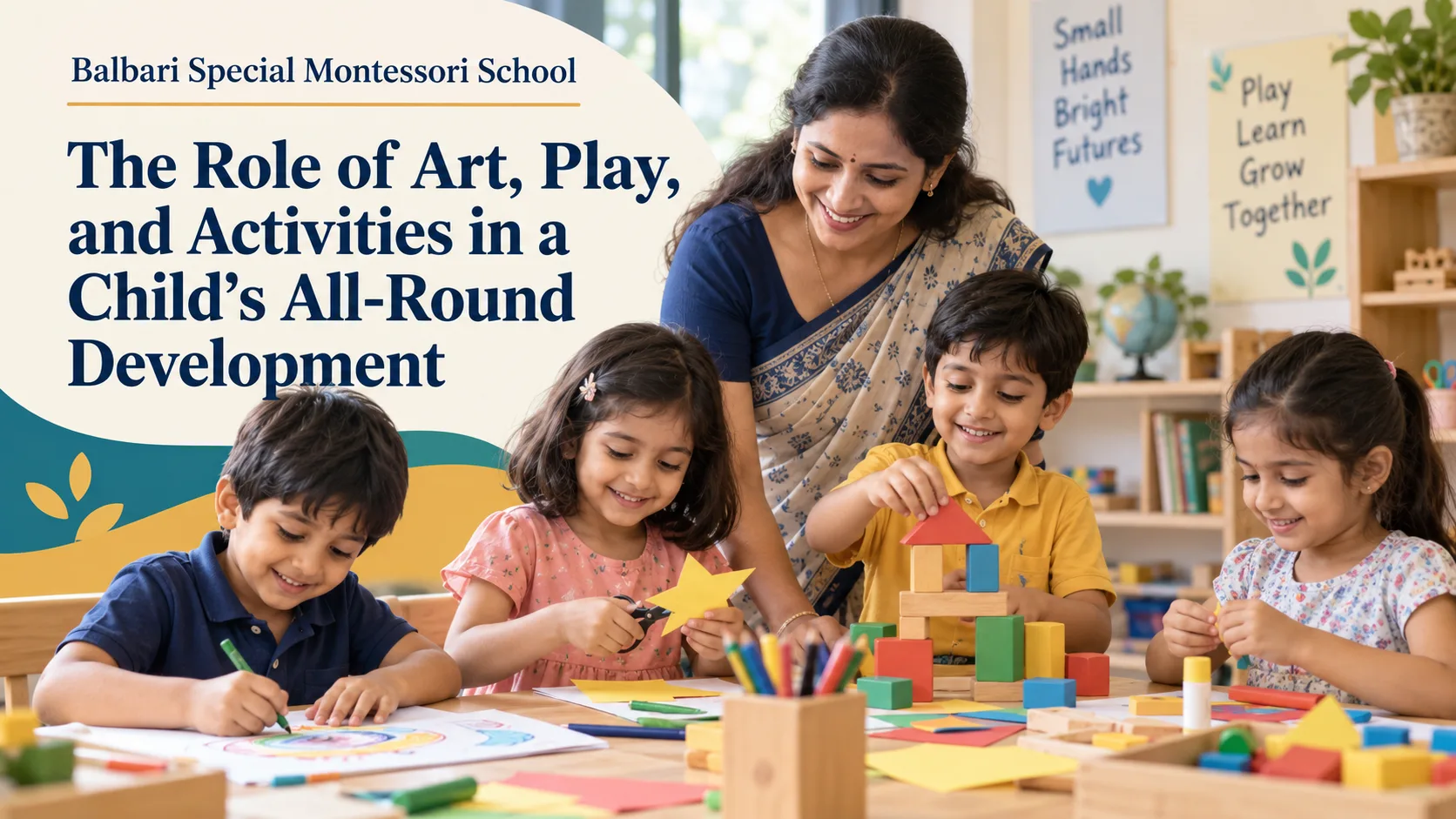
Craft activities often involve a sequence: selecting materials, preparing pieces, arranging them, and completing the work. Children practise following steps while making decisions along the way. Tasks should use age-appropriate materials, and activities involving tools require suitable adult supervision.
There are also opportunities to explore shape, size, texture, and position. A child making a paper house might discuss a square window, a triangular roof, or a door placed below a window. Such conversations connect creative work with language and mathematical ideas. The lesson remains practical because the child can see and handle what is being discussed.
Play creates opportunities for discovery
Play gives children space to explore possibilities. Building with blocks involves balance, arrangement, and experimentation. Pretend play invites children to imagine roles and situations. A simple matching game involves observation and memory. The learning depends on the activity, the environment, and how adults support it.
Adults can observe without directing every moment. If a structure falls, a helpful question might be, “What could make the base stronger?” If children disagree about a role, they may need guidance to take turns or choose another solution. This approach keeps the child involved in thinking instead of supplying every answer immediately.
Movement belongs in the school day
Children need opportunities to move as well as sit and listen. Age-appropriate games, supervised outdoor play, and simple movement activities allow them to use their bodies, follow instructions, and participate with others. A balanced school routine makes space for both active and quieter experiences.
Movement activities can introduce useful ideas such as direction, distance, rhythm, and sequence. Following an obstacle route or copying a movement pattern requires attention to instructions. Group games also provide chances to practise rules and fairness. Activities should accommodate different abilities so that participation feels achievable, with adults focusing on involvement and steady progress.
Storytelling strengthens everyday communication
Stories introduce children to characters, settings, and sequences of events. Listening to a story gives them practice attending to spoken language. Talking about what happened first or what a character might do next encourages them to organise thoughts and explain ideas.
Storytelling does not always require a book. Children can describe a family outing, create a story from pictures, or imagine an adventure involving familiar objects. Adults can support them with simple prompts while allowing their own ideas to lead. The purpose is to encourage expression and listening, rather than correcting every sentence before the child has finished speaking.
Music and rhythm invite participation
Songs, rhymes, clapping patterns, and movement to music give children different ways to join an activity. Repetition makes familiar songs accessible, while new verses introduce vocabulary and sequences. Group participation can also offer a comfortable starting point for children who are reluctant to speak alone.
The focus need not be performance. Children can explore loud and soft sounds, slow and fast rhythms, or repeating patterns through simple activities. Adults should keep the experience enjoyable and appropriate to the setting. Opportunities to listen, imitate, and contribute matter more than expecting every child to sing or move in exactly the same way.
Group activities introduce shared responsibilities
Working together gives children practical experience of cooperation. A shared collage, a classroom display, or a team game requires them to consider other participants. They may need to divide materials, agree on a plan, wait for a turn, or help complete a common task.
These situations can also bring disagreements. That is when guidance becomes especially important. Adults can help children explain what happened, listen to each other, and choose a workable next step. Cooperation is learned through repeated experiences. Expecting perfect behaviour from the beginning misses the opportunity to teach the skills that make successful participation possible.
Participation should be accessible to every child
Children have different interests and comfort levels. One may enjoy drawing quietly, while another prefers movement or speaking in a group. A varied programme gives children more than one way to participate. It also allows teachers and parents to notice strengths that may not appear in written work.
Encouragement should recognise individual progress. A hesitant child joining a song or explaining a drawing may have taken an important step. Adults can invite participation without forcing public performance. When a child needs extra support or an adapted activity, the aim should be meaningful involvement rather than comparison with others.
Bringing balanced activities into home life
Parents can support varied learning without expensive equipment or a crowded schedule. Paper, crayons, reusable containers, picture books, and suitable household objects can provide starting points for creativity and play. Shared storytelling, drawing, and simple games can fit naturally into family time.
Leave room for children to choose and explore. Not every activity needs a worksheet, competition, or finished product. Ask what the child enjoyed and what they would like to try next. A balanced education gives academic work a strong place while also valuing expression, movement, curiosity, and cooperation. These experiences help children take an active part in both learning and daily life.